Guest Post: Getting Intimate With the Ground - A Barefoot Running Beginning

Dan taking his Vibram Fivefingers for a spin!
After seeing folks walking, hiking, running, and most recently, Crossfit-ing in what I've affectionately dubbed "monkey feet" shoes, I figured it was time to learn something about them before I dismissed them as another fancy new fad. In an effort to liberate his feet from the confines of freedom-suppressing running shoes, Dan Herscovitch got himself a pair of Vibram Fivefingers minimalist running shoes and agreed to share his experiences here. In the process, he learned a lot about barefoot running, how to do it properly and some of the biggest beginner mistakes.

What is Barefoot Running and Who Cares?
Barefoot running stems from the theory that early humans were natural endurance running hunters. Case and point: paleontologists have yet to unearth a prehistoric homo sapien sporting a pair of Nike Shox. Barefoot running involves deliberately changing the way your foot impacts the ground. This form change eliminates the shock associated with the heel strike, which is the most common way a runner's foot lands.

Traditional running shoes have wedge shaped soles with more padding under the heel. This shape encourages the runner to land heel first, then roll along the mid-sole until the forefoot makes contact with the ground. The problem with the heel strike is that it generates significant impact force and a corresponding shock wave up the leg and through the knee. Ouch. (For the climbers out there, think of the impact of falling on a static rope instead of a dynamic rope.)

The two other possible landing positions - mid-foot and forefoot first - are more common in barefoot runners. The mid-foot impact occurs when the runner lands with a perfectly flat foot, then rolls forward off the forefoot. With a forefoot strike, the ball of the foot hits the ground first. Impact forces are dynamically absorbed through eccentric contraction of the calf muscle. (Think of falling on a dynamic rope; the rope stretches, spreading out the force of the fall.) For an in depth discussion of barefoot running, I recommend the book Born to Run.

Vibram Fivefingers on the streets of Philadelphia. (D. Herscovitch)
What are Vibram Fivefingers and Minimalist Running Shoes?
Just as baseball players wear gloves to protect their hands from impact while swinging a bat, runners don minimalist shoes as a form of protection for feet. Minimalist running shoes typically have a 2-3mm thick footbed that is uniform throughout, or slightly thicker under the forefoot. They are also flexible, allowing the foot to change shape naturally and freely as it moves.

Vibram Fivefingers are a type of minimalist running shoe that look like slippers with individual toes. Vibram currently has a line of seven shoes created for different uses. The individual toe compartments allow toes to flex and spread independently, though it seems this could be accomplished just as well with the full slipper style. I purchased the Bikila LS model with my REI dividend for road and trail running. The Bikila LS features a slightly groove tread, full upper and the speedlace closure system.

Getting My Barefoot Run On
As soon as I got home from REI, I yanked the tags off the shoes, wrangled all ten toes into their respective cubicles, cinched up the closures and hit the streets of Philadelphia with aplomb and vigor! Translation: I started walking, eyes fixed on my snazzy new polypropylene foot gloves. My traditional heel striking gait felt fine even in the absence of heel padding and I was rolling smoothly into each step. Though I was able to land the elusive forefoot strike, to do this consistently requires a gradual buildup of under-used muscles, tendons and ligaments. Moving between pavement, dirt, gravel and grass, packed dirt felt the best. The Vibram soles held up well over gravel, reducing stabby rocks to a luxurious foot massage. The most obvious difference between the Fivefingers and traditional shoes was on the hills. I was able to fully extend my ankles while my foot retained contact with the ground going uphill, continuously transferring power from my calves. I landed mid-foot on the way downhill; the uniform footbed allowed a more natural landing.

A luxurious foot massage? (D. Herscovitch)
...And Then Comes the Sore
My first barefoot run was five miles and took 40 minutes, a leisurely pace and conservative distance for me. Evidently, not conservative enough...I was SORE. I waited through three days of soreness, the worst in my calves and arches, before I felt able to run again. To prep for run number two (six miles in 50 minutes), I did research on forefoot striking and the general biodynamics of barefoot running. I started the second run with intense concentration on forefoot striking, which lasted five minutes before I'd exhausted all the muscles I wasn't used to using and reverted to heel striking intervals. Running consistently with a forefoot strike may be beneficial, but it is a goal to be gradually realized. I spent the next five days battling the consequences - not only sore muscles, but ligaments and tendons, a bad warning sign.

For run number three, I planned a seven mile route in 45 minutes. I practiced forefoot striking as much as I could, still only managing three or four minutes at a time before "resting" with a heel strike for five minutes. Halfway through the run, which took me 55 minutes, my calves were Jell-O. As I write this post a week later, I can still feel soreness when I point or pronate my feet.

Lessons Learned and Beginner Recommendations
I definitely recommend anyone seeking to try barefoot running start slowly and ease into longer distances much more than I did. Don't think you'll be able to run the same distances you are comfortable with on normal shoes! A group of folks at Harvard created an entire website devoted to "the biomechanics of different foot strikes in endurance running," and I highly recommend reading it. The authors suggest starting out with only a few forefoot strikes at a time followed by a minute of "rest," or heel strikes. It is widely thought that transitioning from heel strikes to forefoot strikes, a runner should take at least a month before even beginning to do easy runs that are fully forefoot. So, get a pair of minimalist shoes and get out there, but don't overdo it! 

Have you tried barefoot running? What shoes do you use? Did you make the common too-much-too-soon beginner mistake? Got any tips? Tell us in the comments!

Dan Herscovitch developed a passion for the outdoors at an early age skiing, rock climbing, mountain biking and backpacking around his Southern Ontario home. An EMT by trade, he now lives in Philadelphia where he continues learning and growing in those pursuits. His recently unearthed passion for distance running prompted him to throw caution to the wind and embark on a barefoot running odyssey. When he's not hitting the Schuylkill Trail with his FiveFingers, he can be found scaling walls at Go Vertical or one of our local crags.


Ready to try barefoot running?
Free Shipping on Minimalist Footwear at EMS.com

A Look Back: Matters of Pride, Camping with an Elk in Jasper National Park and the Columbia Icefields

Warm and wonderful in Jasper National Park.
In the most recent "A Look Back" post, I'd shared a journal excerpt from the first day of my journey from Denali National Park, Alaska to a new job in Philadelphia, over 4,500 miles away. After driving along the rest of the Alcan, through the Yukon, Liard Hot Springs and part of British Columbia, we stopped to camp in Jasper National Park. The journal excerpts continue with an account of our unexpected early morning visitor and moving on from Jasper into the Columbia Icefields for some of the most incredible terrain I'd ever seen.

I awoke feeling restless at 5:30am with an urge to use the facilities. I spend a good length of time arguing internally about whether or not extracting myself from the warm sleeping bag was worth it, or if I could manage a little more sleep until the sun rose and warmed the tent. It's one of those impossibly constant cool weather camping problems; one I was glad to have. Dan and I had switched sleeping bags on account of his being warmer and my body's inability to regulate its own temperature. I'd warmed sufficiently by that point to have shed my very top insulating layer, which included my big, marshmallowy Cornell Athletics sweatpants. (To the Athletics Office: I'm not sorry I didn't return them after graduation. After surviving four years of college swimming, I deserve them.) I'd shoved them to the bottom of the sleeping bag and a walk to the bathroom meant retrieving them. Ah, well.

Dan and the fire I finally managed to make!
I finally decided it couldn't wait and was off to the facilities in our Jasper National Park campground, complete with indoor plumbing. I made a silly comment to Dan about how we were roughing it. He gently reminded me that, despite our outdoor sleeping quarters, the bathroom was a shorter walk from our tent than it had been from my employee housing room in Denali just a week earlier. (I lived in one of a handful of beautiful A-frame housing units in Denali without indoor plumbing. If I wanted to pee in the middle of the night, I had to get dressed and head to the nearest bathroom, a relatively short walk away. Good times!)

I'd wanted to make a fire in the morning and was determined to do so before Dan got up. I collected an armful of dead spruce branches and thought I'd have a roaring blaze in no time. Wrong. After crouching near the kindling and fiddling with my lighter, all I'd managed to do was turn the pile of pine needles and bark from brown to black. I was about to surrender when I heard Dan stir in the tent. It had become a matter of pride. I must get the fire started! I must!! I flicked the lighter one last time and managed to ignite the bundle of wet sticks. Victory! It was almost as difficult to keep the little flame lit, but I managed to avoid embarrassment and ridicule by doing so...barely.

our early morning campsite guest in Jasper National Park.
We missed the 11am checkout time because a bull elk parked himself right next to our tent while we'd gone on a little jaunt into town and couldn't get near the tent to dismantle it without fear of being charged. Back into town we went for a wonderful breakfast of homemade bread and eggs. Aurora (my Toyota Corolla), even completely loaded down with all of our worldly possessions, is consistently getting 30-35 mpg. The elk still hadn't moved when we returned. I slowly and deliberately approached the tent and got close enough to unstake it. We moved it closer to the car, dismantled it, packed up and left, heading south toward Banff and the Columbia Icefields.

the beginning of the Columbia Icefields.
I thought I'd seen it all in Alaska, but I was remarkably mistaken. This section Canadian Rockies, save Mount McKinley, seems to be consistently taller than anything I've seen. The peaks are more jagged, the mountains more angry, and the landscape more intimidating the further we go. Instead of  relatively gentle rises from base to summit, these boast thousand foot sheer cliffs staggered from top to bottom like stairways for giants. The summits of each are extraordinarily obvious and the mountains exhibit obvious sedimentary layers. Most are over 3000m tall and as a result, each have their own little glaciers and ice fields. Most look unclimbable without a harness, lots of ropes, lots of people, and a certain level of disregard for self preservation. Small trees grow improbably in the smallest of flat spots. They stretch toward the heavens above deep blue lakes and rivers fed by the endless glaciers. It's just...inspiring. Do we have to leave?

In the next "A Look Back" post on May 13th, the journey continues through the Columbia Icefields and on a backpacking trip to one of the largest backcountry glacial lakes in Banff National Park!

“Where My Girls At?” Alison Vuocolo’s Quest to Build a Women’s Bouldering Community in Philadelphia

Alison on Firestarter (V3) at Rumney.
Alison Vuocolo started climbing almost two years ago at Go Vertical in Philadelphia, but if you saw her climb, you'd think she's been involved in the sport much longer than that! After countless suggestions from her boyfriend, also an incredibly talented climber, she made it to the gym to help him celebrate his birthday. She was instantly hooked on bouldering and bought both a gym membership and her first pair of climbing shoes within a week. "It's hard to put into words," Alison says, "but as soon as I started climbing, it just seemed like a necessary thing to do all the time."

Through climbing, Alison gained self confidence she never knew she had, and a new way to engage the problem-solving part of her brain. "Climbing is the only physical activity I've ever been able to perform on pure intuition...[it] made me realize my brain has more technical capability than I ever assumed...eventually, your body learns to generate both technical and powerful moves."

After trying out V0 boulder problems and solving them without difficulty, Alison started projecting harder climbs. At a recent bouldering competition, she climbed a 900-point problem without any trouble! Even when some of the guys Alison boulders with tackle problems she can't, she's still confident and says, "...at the end of the day, I'm always so happy that I climb."

Alison on an unnamed traverse at Hunter Rocks
Climbing Like a Girl
Alison noticed a lack of women boulderers at our home gym and that the super hard climbs are largely dominated by men. But instead of accepting it, she's doing something about it. "I was inspired to create a tighter community of women boulderers when I started bouldering outside. " Alison says. "The difference in climbing technique between men and women becomes much more apparent when the problems are on real boulders where the variations in beta are much greater."

Despite being one of the strongest lady boulderers I know, Alison explains she's had a tough time bouldering outdoors with men because of these variations. "They can usually get my projects in one or two goes and I end up climbing by myself or moving on." She longs for a group of girls to boulder with and has seen what having a tight knit community of lady climbers around can do for performance. "I've envied the groups of three or four girls that go together and project the same climbs. Sometimes I'll get on stuff with them, but the whole time I'm wishing that I had that same community."

Alison was also inspired by discussions around Angie Payne's first female ascent of The Automator (V13). "Basically, Flannery [Shay-Nemirow] seemed to believe we would have already seen a female ascent of a V13 if the pro women climbers went on trips together more and projected things together like so many of the male pro climbers do." Alison explains. "You see a lot of videos of strong...female boulderers working their projects solo or with other male pro climbers. It's rare to see a group of strong female boulderers working these hard projects that, up until now, only have 'male beta.'"

Creating a Women's Bouldering Community
Alison rocking an unnamed route at Hunter Rocks.
Alison took a huge step in helping create a community of lady boulderers in Philadelphia by working with Go Vertical general manager Kathleen Walker to set up a three part women's bouldering clinic. She's also getting teaching tips from one of the best female boulderers in the world - Alex Johnson!

The first class is aimed at beginners, the second at women comfortable on slightly harder climbs and the third at all levels with the goal of designing bouldering sessions for progression in climbing. From how to read problems to warming up, from static to dynamic movement, from finding weaknesses to projecting climbs and everything in between, Alison is sharing her expertise with the goal of getting more women out bouldering. By hosting this clinic, she hopes that participants start establishing "their own female-oriented climbing circles. It not only helps make things more comfortable and less frustrating, but also relieves some of the more counter productive female competitiveness too."

The first clinic of the three part series takes place this Friday, April 22nd at Go Vertical. But if you're not signed up already, it's a bit too late; all three sessions filled up in less than two days. To me, that speaks volumes. When asked why she thinks the clinic filled up so quickly, Alison explains, "I had this feeling that a lot of women are just psyched out about bouldering by themselves. I sort of knew this might happen." Hopefully, it will mean a second series of clinics and more women on the bouldering wall at our gym, then eventually, more local women bouldering outside!

Bottom line - women aren’t staying away from the bouldering wall for lack of interest. So then, what is it? Is there a lack of opportunity for women to get involved in bouldering?

Governor Stable Meltdown Outdoor Bouldering Competition Recap

Some Governor Stable boulders, a little wet after the prior day's rain.
Governor Stable, located in Lancaster County, PA, is a 37 acre tract of land with over 100 climbable boulders no more 15 minutes of walking apart. According to Lancaster Online, a group of climbers first secured a lease for ten acres of the land from private landowners when bouldering started gaining popularity. Trespassing problems forced them to shut down climbing for several years, but the Friends of Governor Stable (FroGS) organization recently signed a new lease and reopened the area officially in January of 2011.

Climbing is allowed to members only eight months of the year for a $60 annual fee. “Open Climb Days” are held some weekends throughout the year, and the general public can purchase a $10 day pass to climb there. To me, the membership makes sense. It’s meant to promote responsible climbing and will help preserve access for future generations. Last weekend’s Meltdown Bouldering Competition was my first opportunity to visit Governor Stable, and the first outdoor comp I’ve done.

Meltdown Bouldering Comp Format
After watching rain fall all day Friday, we were all concerned the comp would be postponed. Thankfully, it wasn't, and FroGS assured us the rock was dry. It was, mostly… Competitors had from 10am to 5:30pm to climb and the top ten problems counted toward each competitor’s total point score. No bonuses for flashing problems were given and two fellow climbers had to sign off on each completed problem.

Competitors received a mini guide with a list of every established problem in the area, its name and rating along with a short explanation of how the problem is meant to be climbed. To climb Casablanca (V3), for example, climbers are instructed to “Start on big square cut jug and pull through to a thinner top out.” These one liners certainly weren’t beta, but did help us make sure we climbed each problem from the correct start to the correct finish.

All climbs were assigned a point value from 20 to 1200 and climbers could earn bonus points for climbing a circuit of specific problems. In addition to beginner (V0-V2), intermediate (V3-V5), advanced (V5-V7) and open (V8+) categories, an climbers could enter the "enduro” category and win by climbing the highest number of problems. Strangely, no one entered it!

Paul Esteso on Moby's Dick (V5/V6).
Bouldering Outside Bouldering Inside
I’d considered the intermediate category during preregistration given the grades I typically climb indoors. But, as we all know, climbing outdoors is different from climbing indoors. It almost feels like a completely different sport to me, and the number of days I’ve bouldered outside remains in the single digits. Throughout the day, I couldn’t come close to consistently climbing the grades I’ve achieved inside. I also don’t ever recall a day where I’d managed ten problems at V3 and above indoors! So, into the beginner category I went.

I warmed up on Biscuit (V0) with Paul and two other climbers spotting. The problem is easy, but it had been at least a year since I’d topped out on anything. I reached the top and hesitated while Paul told me I had as much time as I needed. Throwing my toe over the last edge, I mantled up on my right hand and crawled to the top of the boulder, heart pounding. It took all day for the adrenaline rushes to fade each time I came close to topping out. I was, as always, surprised and elated by the support from other climbers!

It was humbling to spend the entire day working problems V3 and below and to battle so much fear on the top outs. Some of the boulders were definitely still wet from the downpour the day before, which made me nervous, as did the thin layer of green moss that had seemingly appeared overnight on some of the surfaces. But with so many boulders in such a concentrated area, there was no shortage of climbing!

The Results
Jed working on my favorite problem of the day, Casablanca (V3)
I had an amazing group of people to climb with. I was, as always, surprised by and grateful for the amount of support I got from strangers. After listening to a group of guys I didn’t know cheer me on side by side with good friend Paul during my first knee-shaking top out of the day, I knew I was among my community. (And FYI, Paul is one of the best climbing buddies anyone could ask for!) When I left my crash pad for friends working Casanova (V6), a complete stranger offered me her pad while I worked Chai Right (V2) and gave me a spot for the downclimb.

My favorite problem of the day was, by far, Casablanca (V3). It’s an area classic with a beautiful jug to start on and a significant lack of footholds to go with it. With enough body tension, I was able to keep my feet on the wall for the first move, a long throw to a knob with the right hand, which you have to hit before both feet peel off. There’s a heel hook and a bump from an intermediate to a crimp, the crux of the climb for me. It took a handful of tries, but I sent it and it was my highest point valued problem that day.

I ended up climbing eleven problems, earning just under 1000 points and winning the beginner category. Sponsors including East Ridge Outfitters, EMS, Climbnasium and Organic were incredibly generous with donated prizes, and my package included a free pair of Evolv shoes. I chose the Hera model and can’t wait for them to arrive! I also can’t wait for the next open climb day. Governor Stable is an amazing place!

Where My Girls At?
There was a significant lack of female representation in general at the comp, and no one entered the Women’s Advanced or Open divisions. In past comps I’ve attended, including PRG’s Winter Burn and the Earth Treks Roc Comp, the number of men competing was twice that of the women competing. Where are all the girls?

Good friend and kickass lady boulderer Alison Vuocolo aims to do something about that disparity at our home gym, Go Vertical. She's leading a women’s bouldering clinic series beginning at the end of April, which I'll write about on Adventure-Inspired next week. Her clinic filled up in less than a week, which says to me it’s not about lack of interest from the ladies. So, why are there so few women competing?

Have you been to Governor Stable? Do you have favorite climbs there? Tell me in the comments!

Sharing the Adventure-Inspired Love with Pemba Serves and Section Hiker!

I've been a lucky girl the past week and a half. Well, all the time, but especially this past week and a half! I had the opportunity to share thoughts this Wednesday and last Thursday about two of my favorite topics outside of the Adventure-Inspired forum, those two topics being Big City Mountaineers and rock climbing.

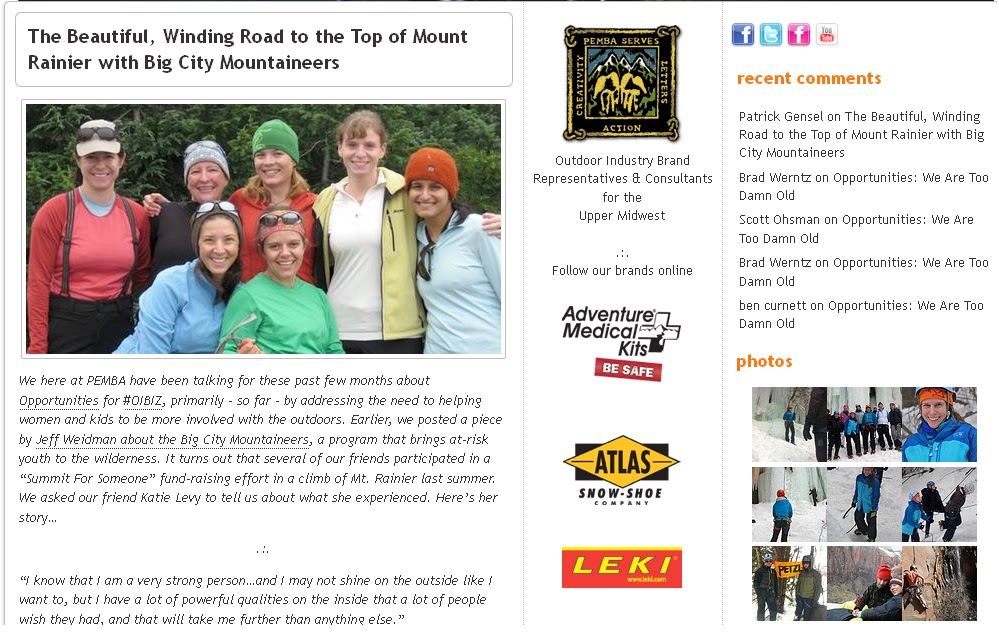
The Beautiful, Winding Road to the Top of Mount Rainier with Big City Mountaineers
There's no quicker way to bring a smile to my face than to broach the Big City Mountaineers and Summit for Someone topics. The organization is has done and continues to do incredible things for urban teenagers by giving them the opportunity to have transformative outdoor experiences. In this guest post for Pemba Serves, learn what my Summit for Someone climb of Mount Rainier in August of 2010 was like from start to finish!

What Rock Climbing Can Do For You
If you read Adventure-Inspired regularly, you know how much I love climbing. Hiking and backpacking are among my other favorite activities, and I'm an avid reader of Philip Werner's Section Hiker blog. Philip took off on a long walk along the Appalachian Trail this month and asked if I'd be willing to write about a topic not often mentioned on Section Hiker - rock climbing! Read more about what I've gained from the sport and why everyone we know should try it.

Keep your eye on both of these forums if you don't already. They're great sources of information! And a huge thanks to both for giving me another soapbox to stand on and talk from!